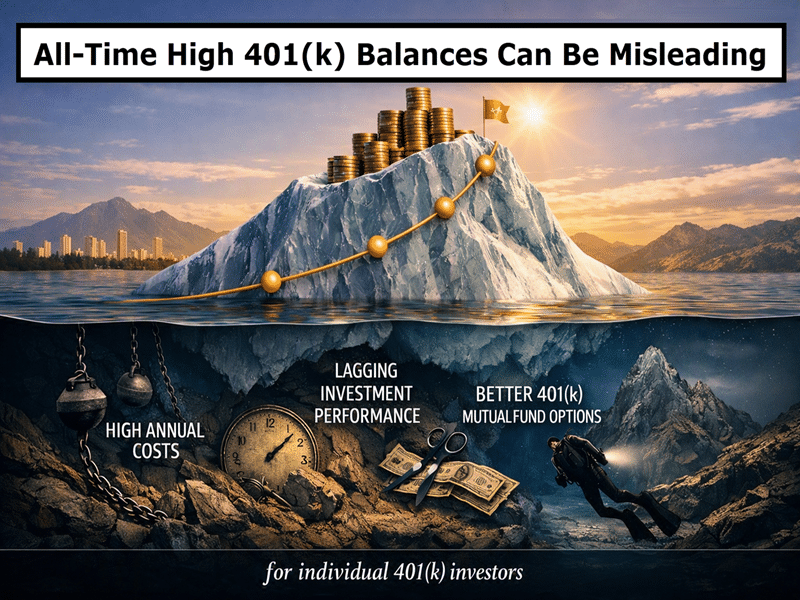
The most common conversation I have with individual 401(k) investors.
Starts the same way.
They show me their all-time high 401(k) account balance.
How much it has increased over the last several years.
They assume their 401(k) mutual fund picks are the main reason.
It never gets old.
The look on their face when I show them the real numbers.
Their personal 401(k) contributions backed out.
Their company-matching 401(k) contributions backed out.
The real investment returns on the mutual funds they own.
Don’t fall into the same trap.
Your 401(k) balance is higher.
Compared to what?
Compared to better 401(k) mutual fund options?
Compared to lower-cost mutual funds?
Compared to a stock market benchmark?
The real answer to your 401(k) investment performance.
Is a calculation of the “cost of the problem.”
The investment gains in your 401(k) you have.
Versus the investment gains you could have had.
You likely use a “buy-and-hold” 401(k) strategy.
What if you bought and held different 401(k) mutual funds?
The ranking of the best mutual funds available in your 401(k).
The “cost of the problem” in your 401(k).
The dollar value of your 401(k) account.
You don’t have due to your poor mutual fund picks.
The investment advice industry focusses on investment performance.
Not enough time discussing opportunity cost.
Earning less than you could have earned in better mutual funds.
The “cost of the problem” in your 401(k) has another name.
The cost of staying the same.
Your current 401(k) mutual fund annual expenses.
How well those mutual funds performed.
Relative to cheaper and better mutual fund options.
There is a real dollar impact to improving 401(k) mutual fund picks.
Don’t continue to measure your 401(k) on total account value.
Measure the investment performance of your mutual funds.
Would you like to see the true investment performance of your 401(k)?
Let’s connect and I can share your details.
P.S. The “cost of the problem” measures true 401(k) mutual fund performance.